Uniting Financial Tools within Amazon’s Transportation Financial Systems
My role:
Lead UX Designer
Project:
0→1 Product Design
Scope:
Research → Product Strategy → IA → Interaction Design → Validation
Impact:
60% reduction in navigation time

How I helped simplify a fragmented ecosystem of financial tools used by 300+ people across Amazon
Amazon’s transportation finance teams relied on more than eight separate tools to complete their work. Each product solved a different part of the financial process, but there wasn’t one place to move between them, understand what needed attention, or request access.
That meant users had to remember where everything lived, maintain multiple bookmarks, and constantly jump between products—especially during month-end close, when accounting teams were working against strict deadlines.
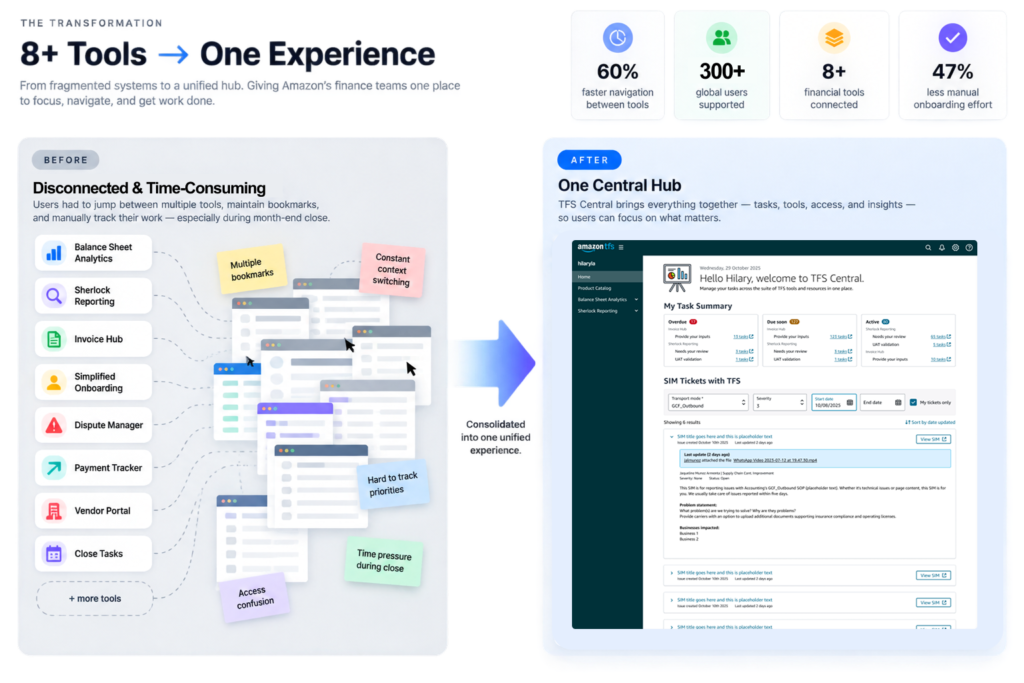
The problem:
Nearly 18% of the workday was spent figuring out what needed attention, while manual processes left room for costly errors and missed deadlines.
Transportation finance had grown into an ecosystem of specialized products. Users might need one tool to investigate an invoice, another to review financial data, another to complete reporting, and another to manage a different part of the accounting process.
Individually, these products served important functions but together, they created a fragmented experience.
This became particularly painful during month-end close, when accounting teams have a limited amount of time to reconcile financial activity and prepare accurate reporting. Every unnecessary search, bookmark, and product switch added friction during an already time-sensitive process.
I saw an opportunity to stop treating these tools as independent destinations and start designing them as one connected product ecosystem within a singular destination as “TFS Central“.
Data driven decisions: Understanding how people actually worked
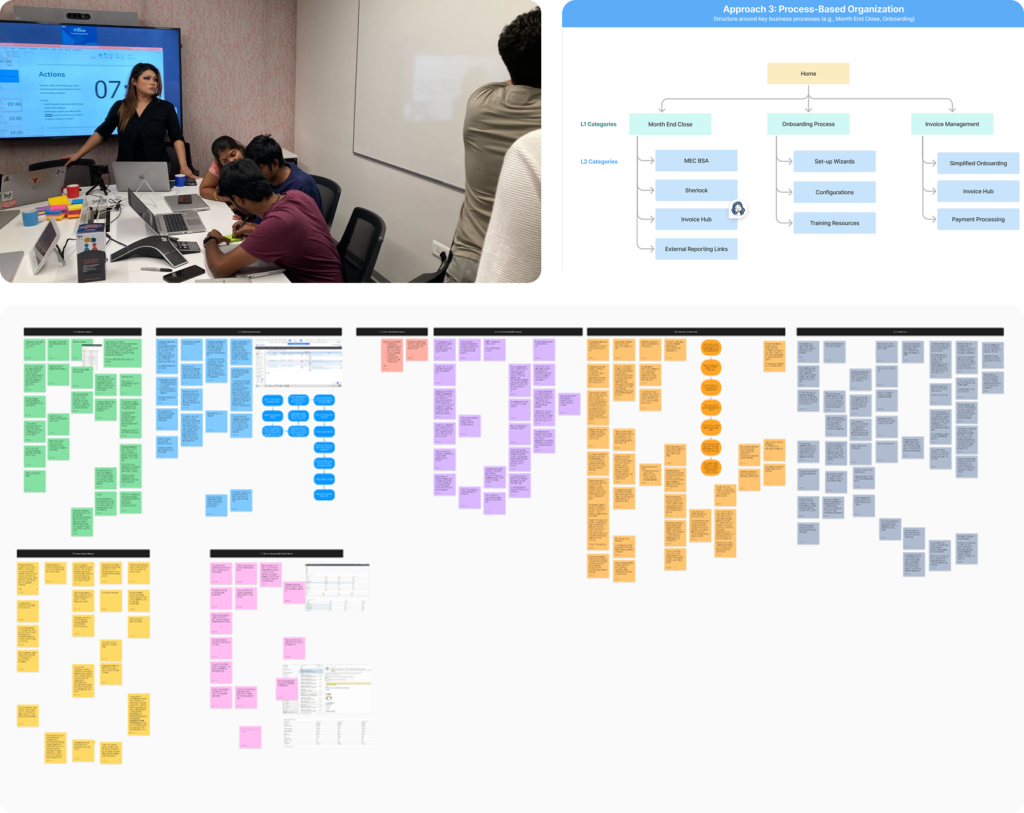
To understand what ‘TFS Central’ needed to be, I needed to see how people navigated the existing ecosystem. I conducted 15+ stakeholder and user interviews, studied workflows across more than eight financial products, and tested early concepts directly with the people doing the work.
The research confirmed one crucial recurring need:
“Just show me what I need to do.”
With 300+ users across different roles and workflows, there was no universal starting point. I needed to create structure without prescribing a single way of working.
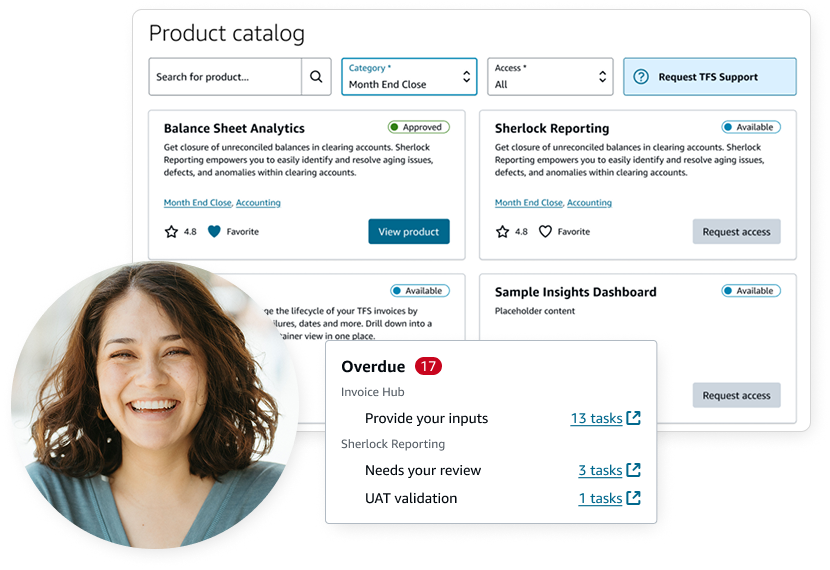
That changed how I thought about the homepage. Instead of primarily organizing the experience around products, I began organizing it around urgency and action, incorporating functionality to support that.
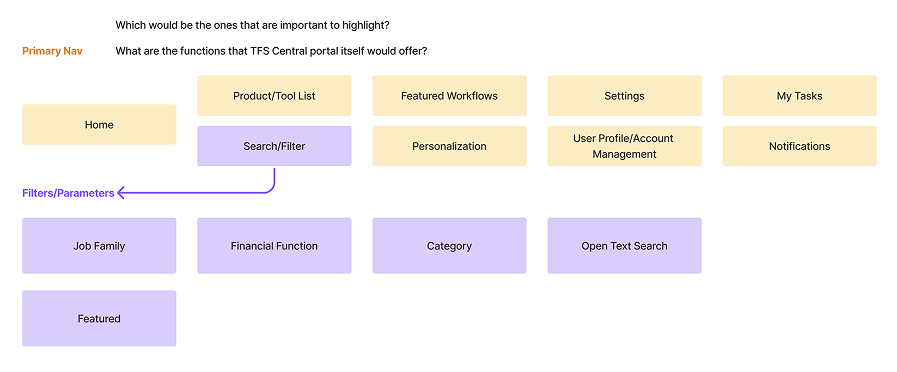
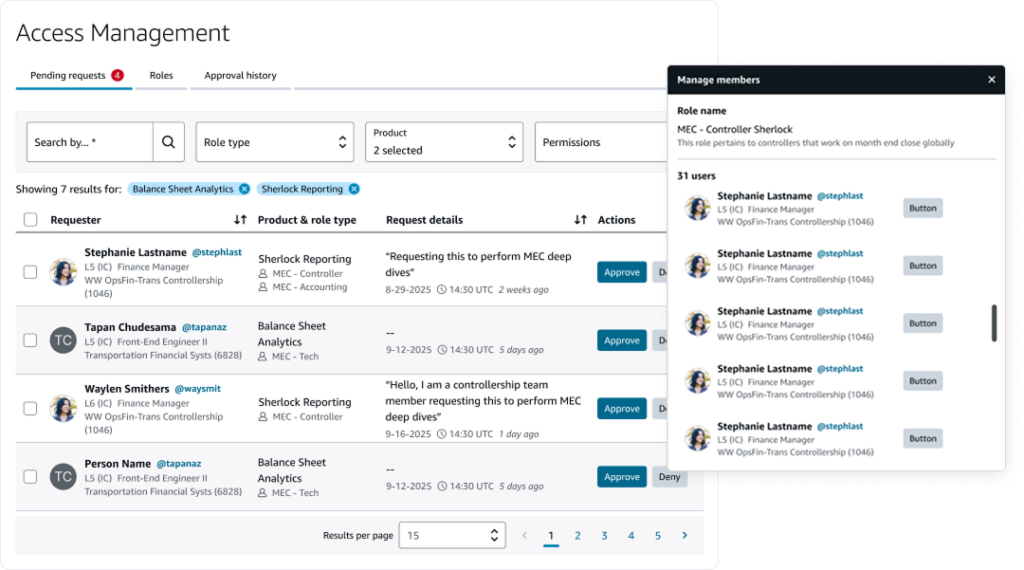
The designed experience combined:
- prioritized tasks and overdue work
- navigation across the TFS product ecosystem
- a searchable product catalog
- role-based product access and access management
- consistent wayfinding between connected tools
Design systems & scalability
TFS Central needed to support an ecosystem that would continue evolving. Working within Amazon’s Meridian design system, I developed reusable navigation and interaction patterns that could extend across the TFS product suite while maintaining consistency with the broader Amazon experience. I partnered closely with product managers, engineers, and finance stakeholders across multiple time zones to balance user needs with technical and business constraints.
That collaboration helped establish a shared experience without requiring every underlying product to become identical.
The outcome
TFS Central gave more than 1,000 global users a single entry point into an ecosystem that previously required navigating numerous disconnected destinations and constant context switching.
More importantly, TFS Central changed the relationship between the products: what had been experienced as a collection of separate financial tools could now behave more like one connected ecosystem.
What this project taught me
TFS Central was beyond just designing another dashboard; it was deciding what complexity users actually needed to see and what complexity the system should absorb for them.
The finance processes underneath the experience remained sophisticated but the interface didn’t need to feel that way.
That became one of the principles I carried forward from the project:
Complex systems don’t need to create complex experiences.
Related Portfolios